
Protect Hawaiʻi’s Beaches and Help Shape New Rules for Our Shorelines
Ensure Hawaiʻi’s proposed administrative rules for our shorelines protect public beaches for future generations.
Protect Hawaiʻi’s Beaches and Help Shape New Rules for Our Shorelines
Hawaiʻi's coastlines are changing. Our rules for protecting them need to keep up.
Hawaiʻi's beaches are already under significant pressure. Roughly 70% are experiencing chronic erosion, and more than 13 miles of beach have disappeared across Kauaʻi, Oʻahu, and Maui, nearly all in areas fronting shoreline armoring.
Climate change is amplifying these challenges. As sea levels rise, waves reach farther inland, increasing coastal flooding, erosion, and risks to homes, roads, and infrastructure. Extreme weather events can compound these impacts, offering a glimpse of the challenges coastal communities will increasingly face.
As more shoreline development becomes threatened, we can expect growing pressure to install seawalls, sandbags, and other protective structures. But Hawaiʻi has historically relied too heavily on short-term fixes to address chronic, foreseeable coastal hazards rather than planning for long-term adaptation.
The problem is that Hawaiʻi's beaches are dynamic, but development is not. Beaches naturally erode, recover, and migrate over time. Development and shoreline armoring can cut off sand reserves that replenish beaches and prevent shorelines from moving inland as seas rise. The result is coastal squeeze: beaches become trapped between the advancing ocean and hardened development, gradually narrowing or disappearing altogether.
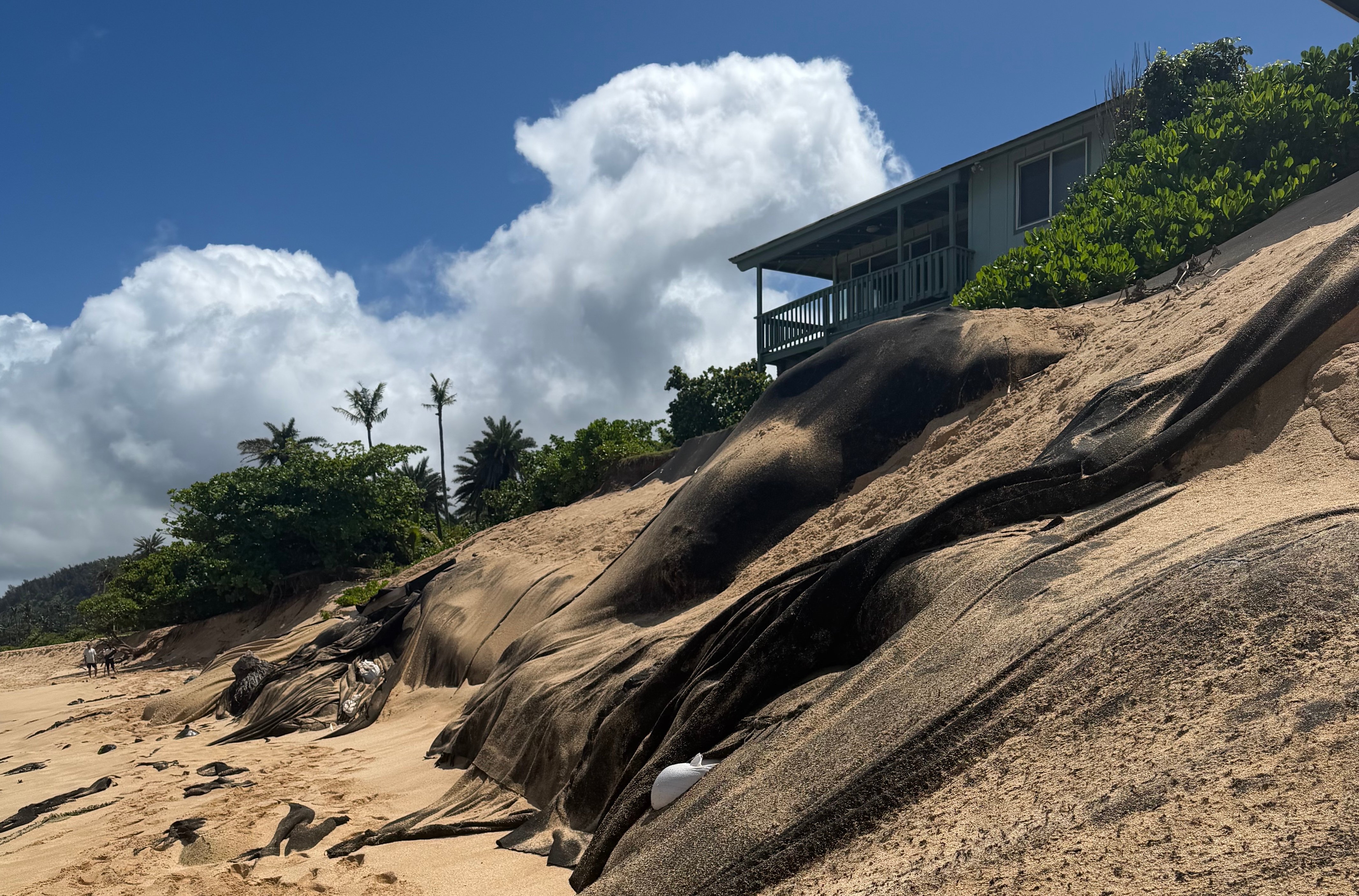
Emergency shoreline protection may be necessary when public health and safety are at risk. But temporary sandbags and erosion barriers have sometimes remained in place for years, even decades, while the public beaches in front of them continue to disappear.
As coastal hazards intensify, we face a critical question: Will our response to one disaster contribute to another—the permanent loss of our beaches?
Emergency protection should buy time for adaptation, not become a long-term solution at the expense of our public beaches.
An Opportunity to Change Course
Hawaiʻi is at an important turning point. The state is proposing significant updates to its Conservation District rules, which have not undergone a comprehensive revision since 2011. Since then, coastal erosion and sea-level rise have created growing challenges that our regulations have struggled to keep pace with.
These regulations, known as Hawaiʻi Administrative Rules (HAR) Chapter 13-5, govern development and activities on certain protected lands, including many beaches, shorelines, coastal waters, forests, and other environmentally and culturally significant areas.
The Department of Land and Natural Resources (DLNR), through its Office of Conservation and Coastal Lands (OCCL), is proposing changes to improve how Hawaiʻi manages coastal hazards, evaluates development, protects natural resources, and responds to emergencies.
Through our Hawaiʻi Beaches Forever campaign, Surfrider Foundation is working to ensure these updated rules protect our public beaches while helping coastal communities prepare for a changing shoreline.
What's Changing?
The proposed amendments are an important step toward better protecting Hawaiʻi's beaches.
Most importantly, they aim to strengthen the emergency permitting process, better distinguishing genuine emergencies from ongoing coastal erosion and addressing longstanding loopholes. They would limit how long emergency shoreline protection can remain in place and require continued temporary protection to undergo greater review by the Board of Land and Natural Resources (BLNR), providing more opportunities for public input and accountability.
The rules would also place stronger restrictions on single-family coastal development, including increased shoreline setbacks, limits on developable area, and restrictions on building in areas vulnerable to erosion, sea-level rise, and certain coastal flood hazards. They would tighten requirements for repairing or rebuilding existing structures, strengthen protections for beaches and public access, and make certain environmental restoration activities easier.
A related proposal addresses small-scale beach restoration. The proposed amendments also incorporate updated standards for beach nourishment, sand pushing, backpassing, and dune restoration, including environmental safeguards, monitoring, and community engagement requirements. Surfrider is advocating for additional improvements through a separate SSBR campaign.
Surfrider supports many improvements to the rules, but important gaps remain to ensure temporary shoreline protection actually leads to long-term solutions.
Where Surfrider Wants Stronger Safeguards
Surfrider supports OCCL's efforts to modernize these rules, but additional safeguards are needed to ensure temporary shoreline protection leads to meaningful, long-term solutions.
Our biggest concern is the proposed new pathway allowing temporary shoreline hardening to remain in place beyond the emergency period under an “ongoing hazardous condition.” The proposed rules require applicants to demonstrate a “concerted effort” toward a long-term solution that would allow removal, but the definition is ambiguous and largely discretionary. Without clear safeguards, this standard could allow temporary structures to remain in place indefinitely while theoretical planning continues.
Temporary shoreline protection must actually lead somewhere — not become another pathway to de facto permanent shoreline hardening.
1. Tie Emergency Shoreline Protection to Long-Term Adaptation from the Outset
Emergency and temporary shoreline protection must be tied to concrete requirements for long-term adaptation and eventual removal. The proposed “concerted effort” standard needs enforceable milestones and clear off-ramps, beginning during the emergency permit period, with continued authorization contingent on demonstrated progress and compliance.
- Establish interim planning and action requirements: Within a defined early timeframe following emergency installation—for example, 120 days—require property owners to demonstrate a feasible, financially viable long-term adaptation and removal plan, along with initial steps toward implementation.
- Require county coordination where appropriate: Where relocation or removal of threatened structures is feasible, require coordination with the appropriate county agencies to identify necessary approvals and establish an actionable path forward.
- Make continued protection contingent on demonstrated performance: Applicants seeking continued protection under BRD-1 must demonstrate meaningful progress toward implementing their plan during the emergency permit period, not simply a commitment to begin planning after approval.
- Establish clear consequences for noncompliance: Set measurable implementation deadlines and limits on extensions, with denial or termination of authorization and removal of temporary structures when applicants fail to meet established requirements.
2. Strengthen Coastal Resource Protections, Monitoring, and Accountability
The proposed rules recognize the importance of protecting beach and dune resources and lateral public access, but the criteria remain vague and largely discretionary. Clear, enforceable standards are needed to ensure shoreline impacts are documented, evaluated, and addressed throughout the emergency and temporary protection periods.
- Make coastal-resource criteria mandatory: Require evaluation of impacts to beach and dune resources, coastal processes, and lateral public access for all shoreline permit applications.
- Establish baseline conditions: Require documentation of beach and shoreline conditions on the subject property and adjoining parcels, including beach width, existing erosion, and lateral public access, before installation where feasible or promptly afterward in genuine emergencies.
- Require objective monitoring and performance standards: Establish site-specific monitoring requirements with measurable indicators of shoreline impacts and project performance. Define monitoring schedules and methods for evaluating erosion, scour, beach loss, impacts to adjoining properties, and lateral public access. Consider fixed cameras or repeat photographic monitoring to document changes over time.
- Establish triggers for corrective action: Require corrective action when monitoring documents accelerated erosion or scour, measurable beach loss, damage to adjacent shorelines, or obstruction of lateral public access attributable to shoreline protection. Require mitigation or modification within a defined timeframe, with removal of the structure if impacts persist or cannot be adequately addressed.
- Ensure transparency before continued authorization: Require monitoring reports, documented impacts, and compliance history to be publicly available and considered by BLNR before authorizing continued temporary protection extensions.
3. Require Mandatory Removal Bonds and Financial Assurance for Shoreline Protection
Financial assurance should be a mandatory condition of shoreline protection, ensuring that property owners—not the public—bear the costs of removing shoreline-hardening structures and restoring affected areas when required. The proposed temporary permit pathway currently states that a surety bond “may be required,” leaving this important safeguard discretionary.
- Require financial assurance throughout emergency and temporary protection: Make removal bonds or equivalent guarantees mandatory for emergency shoreline protection and continued authorization, with sufficient funds to cover removal and shoreline restoration.
- Extend financial assurance to other shoreline-hardening permits: Require appropriate removal bonds or equivalent guarantees for other shoreline-hardening authorizations, including emergency permits, and major repairs to existing structures, with clearly defined circumstances requiring removal.
- Ensure bonds are enforceable and sufficient: Establish standards for calculating and periodically updating bond amounts, and allow the state to access the financial assurance if a permit holder fails to complete required removal or restoration.
4. Strengthen Shoreline Certification Requirements and Establish Clear Adaptation Triggers
Certified shorelines provide an important reference point for evaluating coastal hazards, determining the proximity of development to the shoreline, establishing setbacks and when adaptation measures are necessary. The proposed rules should ensure shoreline certification requirements are consistently applied to emergency and temporary shoreline protection and tied to clear thresholds for action.
- Require shoreline certification: Require a certified shoreline for emergency and continued temporary shoreline protection, with appropriate flexibility to allow immediate emergency work before certification is completed.
- Establish distance-based adaptation triggers: Require a relocation or long-term adaptation plan when a structure comes within a specified distance of the certified shoreline, and require removal at a closer threshold.
5. Make Emergency Protection a One-Time Pathway for the Same Ongoing Hazard
Emergency permits should respond to genuine, unexpected threats—not provide repeated opportunities to protect structures experiencing the same chronic, foreseeable erosion. Without clear limits, property owners could repeatedly seek emergency authorization for an ongoing hazard, delaying adaptation and extending temporary shoreline protection.
Prevent repeated emergency permits from resetting the clock because of a change in ownership, repair, or reconstruction, while preserving the ability to respond to genuinely new, unforeseen emergencies.
6. Strengthen Oversight of Repairs, Reconstruction, and Private Shoreline Hardening
Major repairs and reconstruction can extend the life of vulnerable shoreline development and existing armoring, even where erosion and beach loss are ongoing. Stronger oversight is needed to prevent these activities from prolonging shoreline impacts or avoiding current coastal protections.
- Require Board-level review and public input: Major repairs and reconstruction of shoreline-hardening structures should undergo BLNR review, with opportunities for public testimony and consideration of temporary construction impacts, including beach access restrictions.
- Clarify the 50% threshold for repairs and reconstruction: Establish clear, consistent standards for calculating replacement costs and documenting substantial repairs to both existing shoreline development and shoreline-hardening structures, recognizing the distinct requirements applicable to each.
- Strengthen review of private shoreline hardening: Require consideration of historical beach conditions, impacts to public recreation and shoreline access, and reasonable alternatives, including relocation, particularly where a sandy beach may already have been lost due to existing hardening.
7. Address Existing and Unauthorized Shoreline Armoring
Some shoreline protection structures have remained in place for years or decades under expired or temporary permits, while others may have been installed without proper authorization. These existing conditions present a significant challenge: updating the rules for future projects will do little to address ongoing beach impacts if older or unauthorized structures are allowed to remain indefinitely.
- Clarify how the new rules apply to existing structures: Establish clear transition requirements for older sandbags, temporary shoreline structures authorized under previous permits, expired permits, and structures with unresolved violations.
- Establish compliance and removal deadlines: Require property owners to demonstrate valid authorization and meet applicable conditions within defined timeframes, including removal where structures are unauthorized or no longer qualify for continued protection.
- Prevent indefinite extensions: Ensure existing temporary shoreline protection is subject to enforceable removal requirements rather than being allowed to continue indefinitely through repeated renewals or changes in ownership.
The Bottom Line- Hawaiʻi cannot continue responding to predictable shoreline erosion one emergency permit at a time.
We need rules that encourage earlier adaptation, provide clear accountability when temporary protection is necessary, and prevent existing development from locking in further beach loss.
Surfrider supports moving these amendments forward with stronger safeguards that protect Hawaiʻi's beaches for future generations.
The goal is not to prevent the state from responding to genuine emergencies. It is to ensure that emergency protection buys time for adaptation rather than becoming a long-term solution at the expense of our public beaches.
Make Your Voice Heard
DLNR is accepting public testimony on the proposed amendments to Hawaiʻi's Conservation District rules until November 30th. These decisions will help shape how Hawaiʻi manages shoreline development, emergency protection, and natural resource conservation for years to come.
You don't need to be a coastal scientist or legal expert to participate. Your experiences with beach loss, shoreline erosion, coastal flooding, or public access can help inform the state's decisions.
How to Submit Testimony
Submit written testimony by email:
To avoid uncertainty about the submission deadline, email testimony by November 19, 2026. Mailed comments may be postmarked through November 30, 2026.
You can also mail comments to:
Office of Conservation and Coastal Lands
P.O. Box 621
Honolulu, HI 96809
Include “HAR Chapter 13-5 Proposed Amendments” in your email subject line.
Review the draft amendments and supporting materials on OCCL's Proposed Rule Changes webpage.
Public Hearing Schedule
DLNR is holding in-person hearings across the islands. All dates are in 2026.
Check OCCL's official hearing schedule for complete addresses and updates.